


The Imari Kawanami Shipyard (伊万里川南造船所) is a favourite among haikyo fanatics not least because of its infamous history, but also the way nature is reclaiming the area. Light pours through gaping holes and insects dance in the beams; vines climb every wall and concrete slowly crumbles.
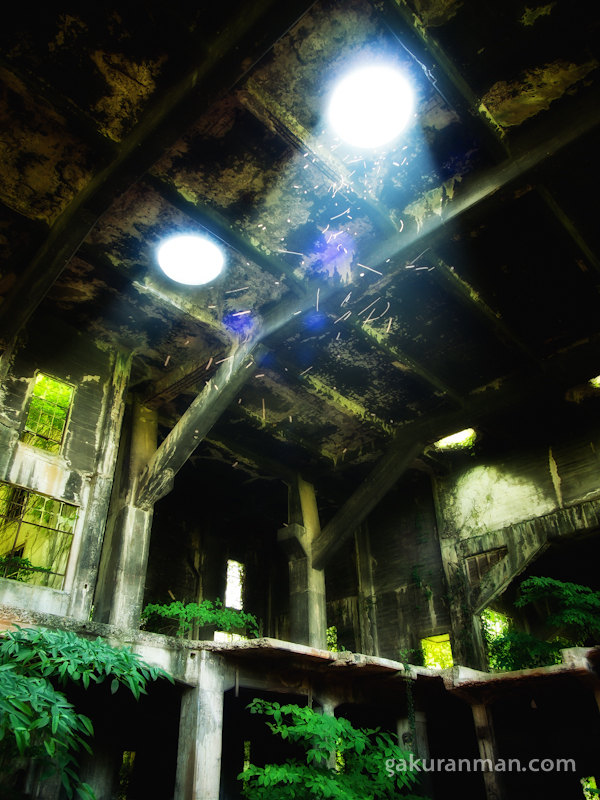
Before we get to the pictures and story, let’s start with a little background. Also called the Kawanami Uranosaki Industrial Shipyard (川南工業浦之崎造船所), at its highest point the place housed over 2500 workers, including schoolgirls and Korean nationals. According to ‘Imari Furusato to Tokuhon’, the Uranosaki shipyard was used as a munitions factory in 1943 as well as to build various types of boats, such as cargo ships and coastal defence vessels. This also included the notorious ‘kaiten‘ (回天) – the suicide torpedoes driven by a human being.
After World War II had ended, the factory continued building and repairing ships, but finally closed down in in 1955. Recently there have been calls for its demolition in order to turn it into a public park, and in response to that, the voices of ruins aficionados also raised in an effort to promote the historical and cultural value of keeping the structures as they currently are. (Yomiuri).
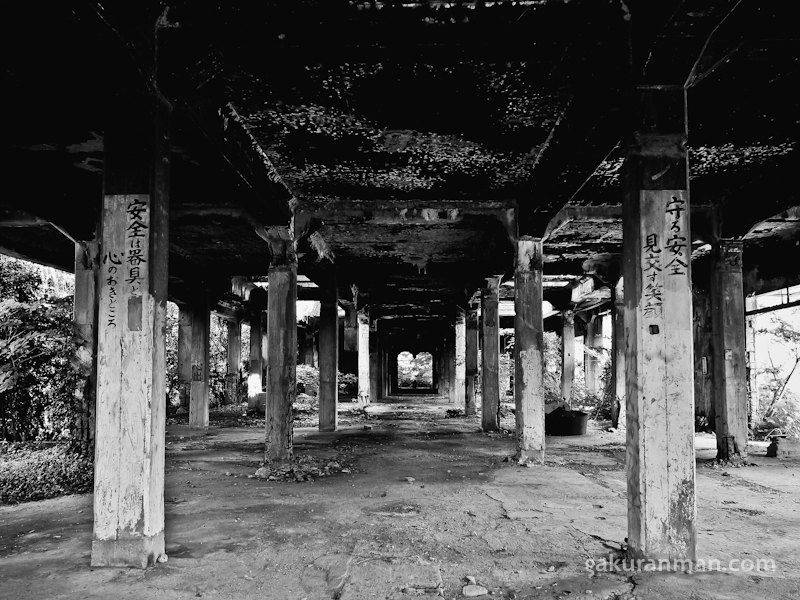
Ikumi and I visited Kawanami as part of our Nagasaki haikyo tour this past summer. After returning from Gunkanjima, Ikumi pioneered the rental car to take us to several other great locations. Kawanami impressed me instantly.
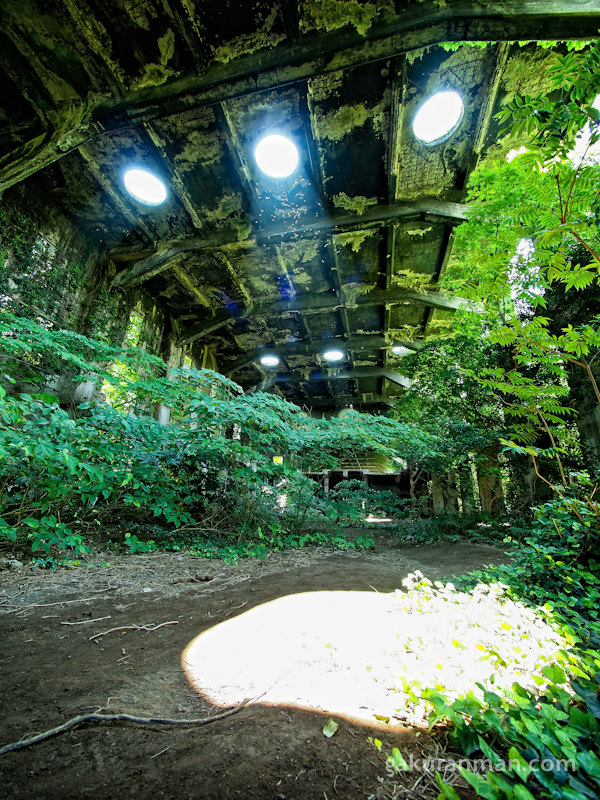
Albeit being just the concrete bones of its former factory, the manner in which nature is stealing back the man-made structures captivates most anyone who decides to visit. The splashes of green leaves and golden light filtering through holes in the roof seemed more reminiscent of a painting than real life. I think I would have been completely swept away if it weren’t the constant reminder of the wildlife around me.
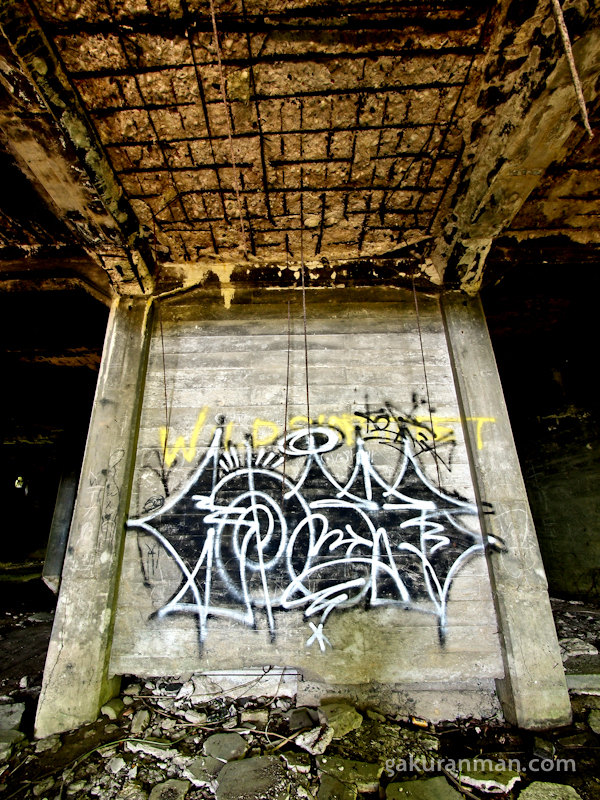
We scouted around the two main areas quite quickly shooting the insects flying around in the sunbeams and sampling the graffiti and old Japanese text written on the factory walls. They seem to be various short sentences related to safe working and health. Not exactly sure what they are though, so if you know, drop me a line in the comments!
Before long, curiosity got the better of us and we yearned to climb up to the second floor of the factory. But it quickly proved to be anything but easy. All the staircases that may have been there were gone and it was a good 3 or 4 metres upwards.
We faffed around for an hour placing rotten logs and branches in a pyramid-like structure against one wall to get higher. Grasping some vines hanging down the wall I began to hoist myself up. I revelled in the manly feeling of becoming the Jungle Book kid for a while before realising how immensely risky the whole thing was.
The vines were fat and sturdy-looking, but I couldn’t be sure they would continue to hold my weight. Ikumi’s story about gashing her ankle last time she tried to climb up didn’t help reassure me and neither did the ominous humming coming from above. The last thing I wanted was to encounter a swarm of suzumebachi.
Abandoning that plan, we sought another route. Much more time passed and much more faffing. Eventually, we climbed a tree that had a branch overhanging the second floor balcony. If I had been 13 years old again this would have been a 5 minute job, but since I’m now overly cautious, it took us a whole hour to gain the confidence to put our lives in the limbs of the tree. It was a fine tree however, and we scaled the gap, grinning gleefully about our daring feat.
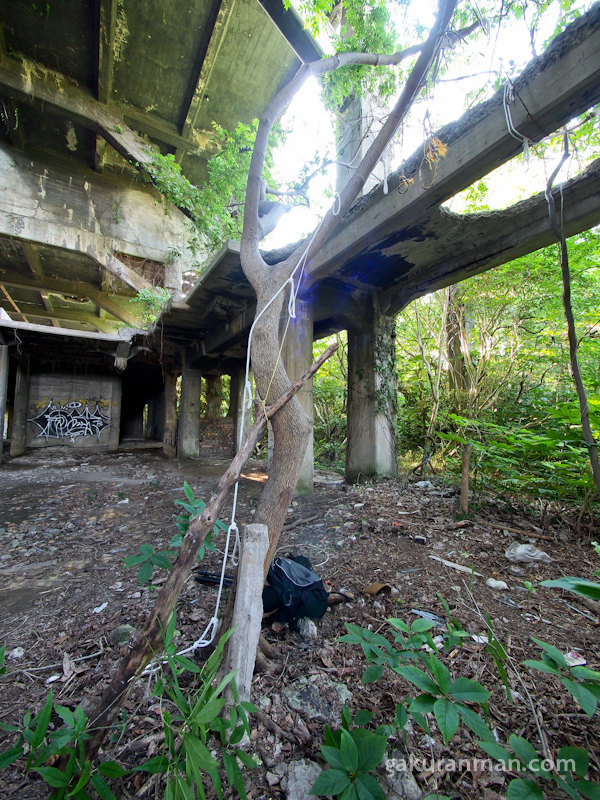
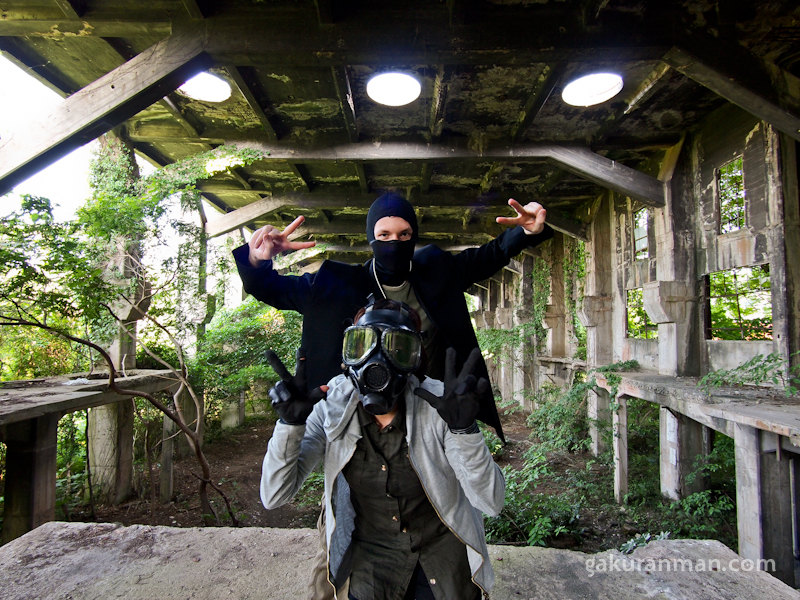
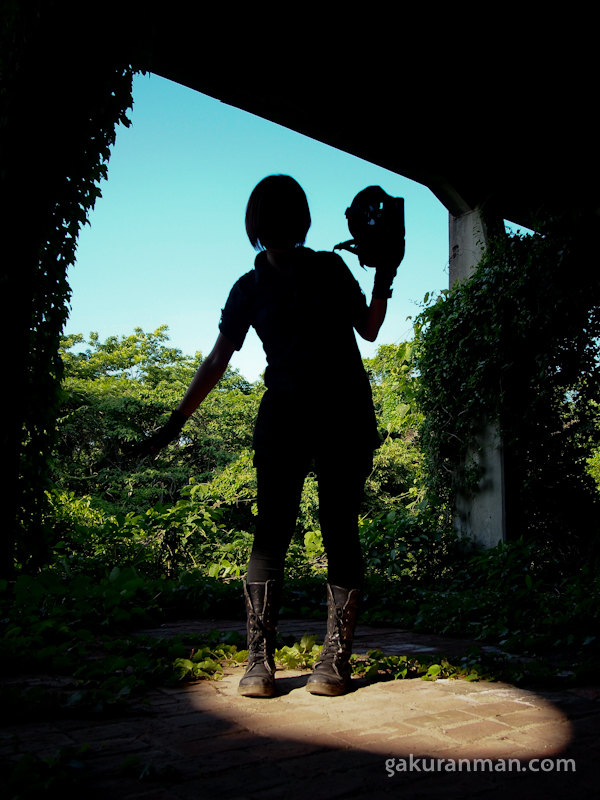
Once up, much photography and self-posing. Reflecting back now knowing a bit more about the history of the place, I suppose it seems a little disrespectful, but I think it can also be seen as a positive sign of the way history leaves relics to be re-used and re-invented in the future. Not in a destructive sense of course – I would hate for Kawanami to be torn down in place of a public park – but for individuals who re-discover it and make it into something their own.
The second floor was completely empty however, save for a few cool vines and rusty objects. Ikumi did manage to find a pair of girl’s pink panties though which, while quite a cool spot for a bit of aokan, would require a significant amount of effort climbing to achieve!
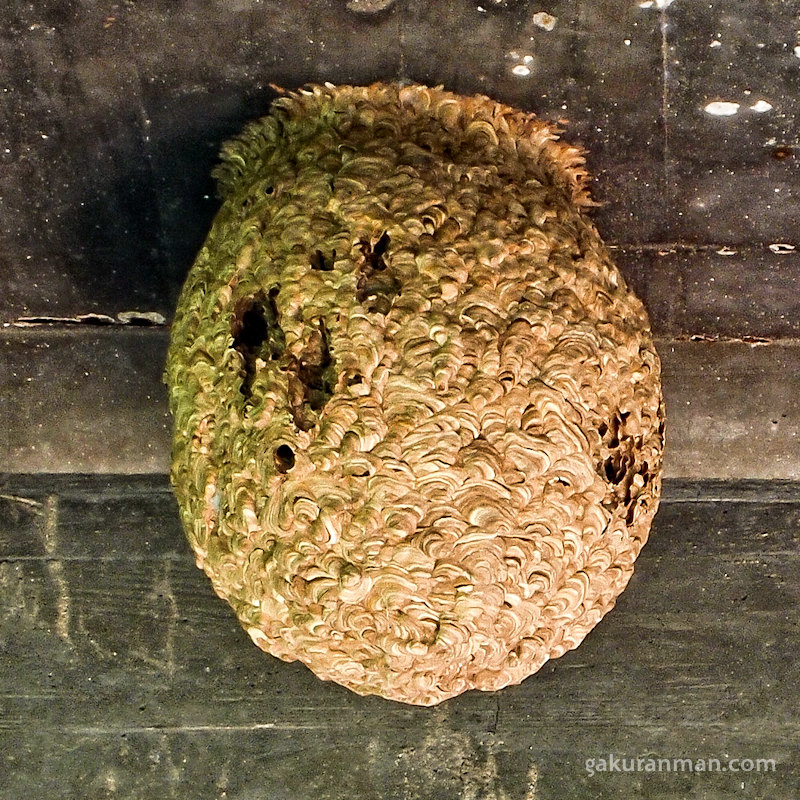
Oh, there was one other thing. And thank god that it turned out to be empty. Guessed it? Oh yes. Those Giant Asian Hornets. A massive nest bloomed against the concrete ceiling with a hole the size of a small mouse to enter and leave. Judging by older photos of this haikyo, it appears the nest has been there for a while, but I don’t know if it’s still in use by the bees. Needless to say, I tiptoed well around the area while carefully shooting it. A sting from those bees can kill.
The day grew old and it was time to leave. We hadn’t even thought about making the 30 minute walk towards the sea to view the other parts of the shipyard as we were having so much fun climbing and using the natural spotlights for poses. Perhaps a return trip is in order?
It will have to be soon however. Plans to demolish the place are already underway and it is scheduled to be done next year. That is, unless the voices of fellow explorers and lovers of history are heard. One Tomohiro Umezawa is leading the way in the fight, and I encourage you to spread the word if you feel the place is worth saving. It has great historical value, naturally, but also cultural significance in the battle to educate the new generation about the atrocities of war and why it should not be repeated. Not to mention that it’s just bloody beautiful the way it is.
Hey Michael, just to let you know: The shipyard is gone. I’ve seen photos and a video… R.I.P.
Any chance you could show me them? Sad to hear :(
The shipyard was still there when I visited it a couple of weeks ago – no signs of imminent demolition. I’ll publish an article next week to start a series about my second visit to Kyushu.
BTW: The seaside part of the shipyard is a 3 minute walk, it doesn’t take even close to 30 minutes to get there.
Good to know! Maybe if I ever go back I’ll get out to the seaside part. Did you climb up to the second floor by the way?
To me the seaside part was
way more impressive than the shipyard itself – but I didn’t climb to the second
floor… I’m too big and the tree looked way too frail. Of the five or six
people I met there only two climbed up – although all of them were about half
my size…
故郷が伊万里の者です。
先日久しぶりにここに撮影に行った時、茨城の方がgakuranmanさんのサイトを見てここに来ていました。
なんだかこうやって寂れていく地元に来てくれた方がいたり、
そのきっかけを作ってくれたあなたにありがとうと伝えたくなりました。
書き込みどうもありがとうございます!とても残念なお知らせですが、伊万里川南造船所はつい先週撤去することになったみたいです。今年中で行われるらしく、まだみたい部分があればみんな早く行ったほうがいいのですね。本当にこのニュースにがっかりしています•••
http://www.yomiuri.co.jp/e-japan/saga/news/20110623-OYT8T01199.htm
返信ありがとうございます。そうなんです。前々から解体の話はでていたのですがついに決定したみたいです。
戦争遺産であるために残したほうがいいとゆう意見もあれば、壊したほうがいいとゆう意見もありました。
遊び場が一つなくなりますがこれも時代なのかもしれません。また是非伊万里に来て下さい★
facebookのほうで友達登録ありがとうございます!facebookのほうではishimaru kenichiroとゆう名前です。
これからも素晴らしい廃墟写真を紹介してくださいね!ではでは。
サンキュー。これからも廃墟の写真アップします!取り壊される前にたくさんのところに訪問しないといけませんw。
My father worked on this shipyard as a prisoner of war during WW2. They were held in a POW camp nearby (there is a High School on that location now)
called Fukuoka 2. Hundreds of POW’s, Dutch, American and British worked here in terrible conditions. Safety was not an issue by the Japanese.
Strange to see these photo’s. Agree it should be preserved as it is…..
Wow, that first photo is amazing! It almost looks animated and like it’s under water O.O
That’s a helluva hornet’s nest. I like trying to use the light from the circular windows in the shots.
Was it possible to shoot from a high vantage point? I see lots of low angle shots, but none shooting from above.
Yet another way to differentiate oneself from other people that have been to these haikyo spots: attach a cable release to your camera, put it on a tripod with legs extended but closed. Hold the tripod way above your head. Using the cable release you now have a photo angle around five feet higher than anyone else.
When I see your haikyo partner I just thing Girl with the Dragon Tattoo for some reason.
Thanks for the tip Jason :). I’ll give that a try next time – even without a cable release, the built-in timer would work too. Will be tricky to hold things steady in that low light though!
Ah, the low light yes,,,,would be touch, would have to lean the tripod/camera against a wall probably….could use an external flash also.
I really love all your haikyo pictures, edited or otherwise. I wonder if you spend a really long time setting the shot up or if you are just jammy?!
Hey there. I spend a bit of time thinking about how to best capture the picture and express the scene. It isn’t just point and shoot, if that’s what you mean. Saying that though, the beauty of the places and post processing techniques I’m learning all help to further improve the pictures!
Those are some really awesome locations, being there is like having Bernard’s watch.
Is haikyoing something you did back home or something you started here? I would love to see some of your pics from back home if you did. I tried once, but they are either full of junkies or renovated almost immediately.
Actually, yes, I began the hobby back in the UK. I plan to post a few of those locations up in the future :).
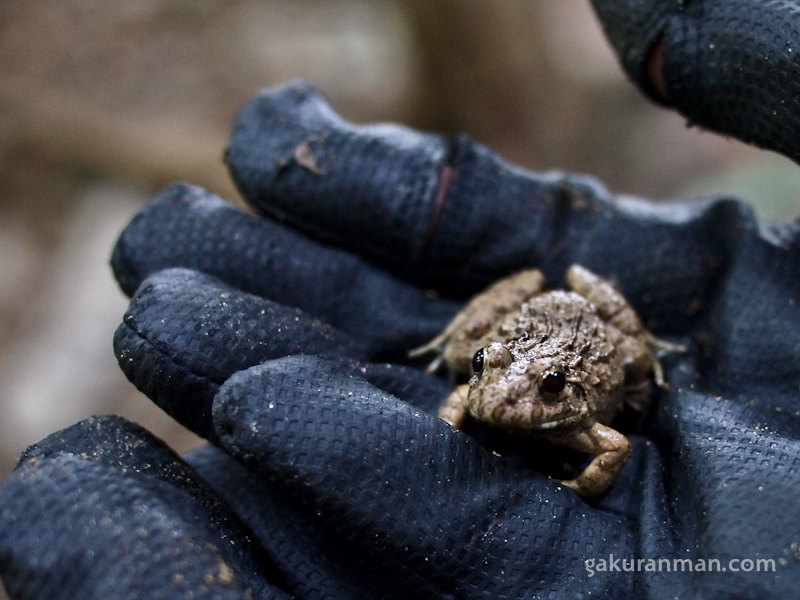
カエルかわいいw
二階に上るのにとても苦労したけど
楽しかったね!
ハチノス・・・・こんなに大きかったっけ?w
はは。蛙よく捕まえたね!蜂の巣はドアップしたから大きく見える。でも、確か洋式便器の大きさくらいかな?恐ろしい・・・
The boldness of the youth… I’ve seen this place so often, but I can’t remember shots taken on the second floor – it’s interesting how you always put your own spin to the locations. I can’t wait to see more of your Kyushu haikyo!
Thanks man :). I like to try and keep things fresh. More excellent kyushu haikyo in the works!
Your picture composition is improving as you go along. :D I dig all of these.
Thanks :). I definitely feel that I’ve grown a lot from my photography 6 months ago. Some of that is hardware related (new lenses), but a lot is photo editing and tweaking images to get the right feel. I used the ‘glamour glow’ filter on the top image this time which every it that soft, dreamy effect.
Thanks :). I definitely feel that I’ve grown a lot from my photography 6 months ago. Some of that is hardware related (new lenses), but a lot is photo editing and tweaking images to get the right feel. I used the ‘glamour glow’ filter on the top image this time which every it that soft, dreamy effect.
That hornet nest would freak the hell out of me.
Yea – I was extremely careful walking around it at first until I was sure it was empty.
Love it! Really wish I can join u on these adventures! & how can we help stop the demolition of the Imari Kawanami Shipyard?
Cheers Nicholas. Drop me a line if you ever come to central Japan! As for the shipyard, it will be hard, but informing more people about its importance is a start. Could always write to the Nagasaki government and other newspapers in protest too :).